Mentalism is a performing art practiced by mentalists. Mentalists manipulate thoughts, perceptions, and behaviors using psychological techniques. Mentalists, known as psychic entertainers, perform mindreading tricks for entertainment. Mentalists achieve this by skillfully using psychological techniques such as cold reading, hot reading, body language, observation of ideomotor responses (nonverbal micro-expressions such as eye movement), NLP, suggestion, and misdirection to create illusions of extraordinary mental abilities or demonstrate psychic phenomena. The mental abilities and psychic phenomena exhibited by mentalists include telepathy, precognition, clairvoyance, mind control, and psychokinesis. How do mentalists do it?
The thought readers
How mentalists manufacture mind reading
In the theater of mentalism, the human mind takes center stage. On this stage, perceptions, thoughts, and secrets are to the mentalist as tangible as playing cards in the hands of a magician.
A mentalist crosses the invisible landscape of your mind, hops through the labyrinth of your thoughts, predicts your decisions, and influences your behaviors.
What is a mentalist?
Mentalist definition
Mentalists use psychological techniques to create the illusion of extraordinary mental abilities. such abilities include mind-reading, precognition, superhuman memory, and rapid calculation.
A performance artist who demonstrates mental tricks for entertainment.
A magician masquerading as a mind reader.
A practitioner of the branch of magic referred to as mentalism.
“Magic is the orchestra of the seen. Mentalism is the silent music of the mind.” — Jon Finch
One of the mentalist personality traits is curiosity. Mentalists are exceptionally curious people. Exceptionally curious people tend to be exceptional readers. The Thirteen Steps to Mentalism is “the Bible of Mentalism.” Corinda’s masterpiece is widely regarded by celebrated mentalists as the best book on mentalism magic. Mentalists regard this book with reverence.
Mentalist meaning
A mentalist is a performance artist who demonstrates what appears to be fantastic mental feats. these extraordinary mental effects rely on technical skill, misdirection, psychological subtleties, hypnosis (suggestion), cold reading, and showmanship to demonstrate what appears to be extraordinary mind reading, foresight, clairvoyance, and telekinesis.
Magic is Appearing To do the impossible. Mentalism is Actually Doing the highly improbable.
Magic elicits the question, “How did you do that?” Mentalism evokes the question, “How did you know?”
A magician offers a dazzling display for the eyes. A mentalist is the tour guide of your imagination.
Magic is doing the impossible. Mentalism is knowing the unknowable.
When spectators view a magic show, they are surprised, wonder, and astonished. Rarely does the performing art shift the spectator’s view of how the world works. When the magician snaps his fingers, waves the magic wand, or sprinkles woofle dust, the spectator knows the Magician doesn’t need the woofle dust.
But when spectators witness a psychic entertainer like Uri Geller or a mentalist like Koran, many are left wondering whether the mentalist has mental magic feats like clairvoyance, telepathy, or ESP is an expert at mind control or can read minds. For a mentalist, the woofle dust is “body language reading” or “NLP” or even understanding human behavior or some other plausible explanation. Spectators believe in the mentalist’s woofle dust.
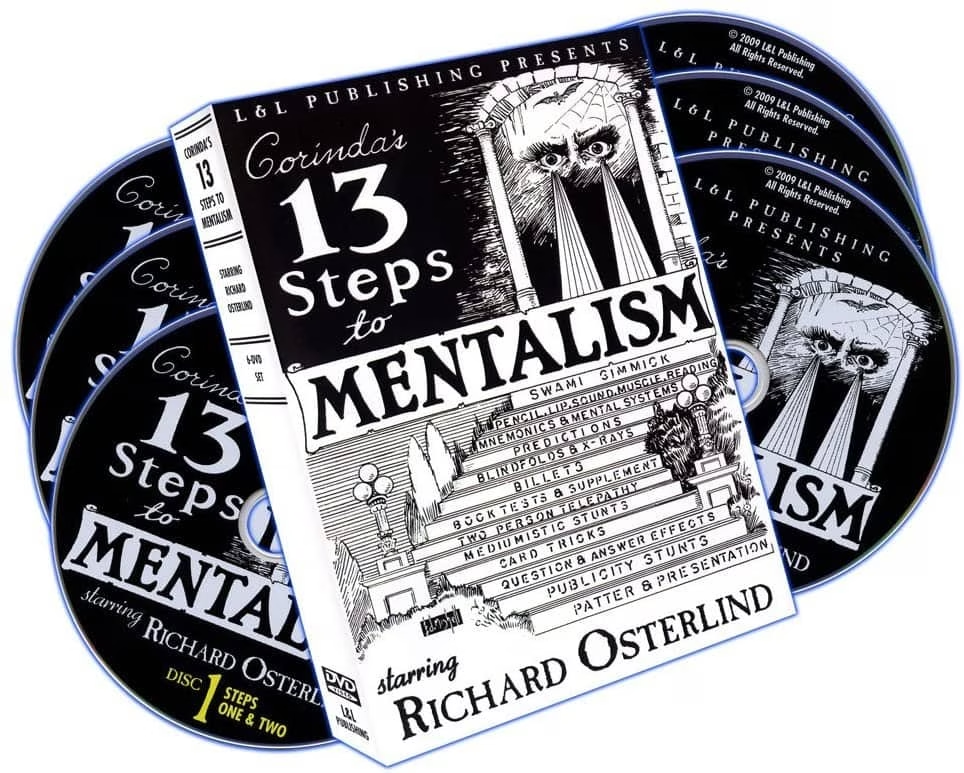
Become a mentalist with the 13 steps to mentalism video set.
Guided by the expert mentalist Richard Osterlind, this 6-disc collection is a goldmine of mentalism techniques, effects, and insider tips. This video set offers 12 hours of mentalism learning designed to hone your mentalism techniques. Click on the image to master the art of mentalism and leave the audience in awe.
10 mentalism terms
Mentalism
Mentalism is a performing art that involves manipulating perceptions, thoughts, and actions through psychological techniques.
Cold reading
Cold reading is the ability to gather information about a person without prior knowledge by using general statements and observing responses. It is like shooting an arrow and painting the target around where the dart lands.
Hot reading
Hot reading involves obtaining information about a person before a performance, usually through research or covert methods.
Body language
Body language is nonverbal communication through facial expressions, gestures, posture, and movements that can reveal a person’s thoughts or emotions.
Microexpressions
Microexpressions are brief, involuntary facial expressions that indicate a person’s true emotions, even when trying to hide them. They are called ideomotor responses.
Eye movement
Eye movement is the direction and pattern of a person’s gaze, which reveals thought processes.
NLP (neuro-linguistic programming)
NLP is a communication approach focusing on understanding and influencing thought patterns, behaviors, and language.
Suggestibility
Suggestibility is the degree to which a person is susceptible to influence, and it is used in mentalism to guide the subject’s thoughts or actions.
Misdirection
Misdirection is a technique for diverting attention away from a secret action or manipulation, allowing the mentalist to create an illusion of psychic ability.
Psychological principles
Psychological principles are concepts and theories about human cognition that mentalists employ to predict, anticipate, and influence people’s thoughts and actions.
How does mentalism work?
Mentalism works through psychological techniques that create the illusion of extraordinary mental powers, such as telepathy, precognition, mind control, and psychokinesis. These techniques include psychological manipulation, suggestion, misdirection, cold reading (making accurate assumptions by picking up on cues from the person’s behavior, body language, and speech), hot reading (using prior knowledge about the person), and a deep understanding of human behavior. Mentalists use these skills to create convincing illusions of psychic phenomena, entertaining audiences with their apparent mental prowess.
The mentalist forces a thought onto a participant and then pretends to guess the forced thought.
The mentalist divines a genuine selection using trickery.
The range force—a combination of the force and divination.
A thought is forced any time a participant makes an inevitable choice. The mentalist leads the participant into Choosing a name or number. The real trick with a force is to make the “free” choice appear Convincing, Without making it appear contrived. The second way mentalism magic works is when the participant makes a genuinely free choice. Performers must gain the info through subterfuge. In the past, a volunteer may choose a book in the library and choose a word from that book. During the 1570s, Italian magician Girolamo Scotto performed for audiences using sleight-of-hand magic — Girolamo Scotto was the earliest recorded performance of mentalism. In 2024, there’s no limit to how many words are on Wikipedia, A volunteer may pull out her phone and think of a word from her favorite website. It’s no longer necessary to go to the library. More on that later. The range force combines forced thought selection and divination by body language cues, unconscious feedback from the participant, the power of suggestion, forked patter, and, in some cases, a Hufflepuff.
forked patter magic spell how mentalists read minds
As an opportunist, the mentalist may pickpocket a wallet to gain info such as the participant’s name, birthday, and star sign.
Are mentalists merely magicians doing magic tricks?
Yes, mentalists are magicians doing tricks.
Yes.
Mentalists are magicians.
A mentalist is a type of magician since mentalism is a branch of magic.
When deciding if a performance is magic or mentalism, a simple question you can ask yourself is, “Could this happen by chance?”
Should this trick happen only 1 in 100 times, even though the mentalist is performing it repeatedly? Or should this trick never happen, according to the known laws of physics? Consider the most well-known card trick. You take a card. Shuffle back into the deck. The magician finds your card. You might think of this as a magic trick. But it’s a mentalism feat.
Yes, you read that right.
mentalism Dr Phil psychology how mentalists read minds
No “magic” happened. At least not in the discovery of the card. The revelation of the card is magical (and entertaining). How do you perceive the difference? Ask yourself: If the performer were blindfolded and reached forward to pluck a card from the 52-card deck, would he grab my card, given a hundred attempts?
The answer is a resounding yes!
finch magic illusion
Odds are, a mentalist (or any human), would find your one card out of 52, if given a hundred attempts. What makes it astounding is the mentalist correctly guesses the card whenever he wants.
What is a magic trick, then?
The linking rings is a magic trick. Solid steel rings melt through one another. It’s not just an unlikely coincidence. It’s altogether impossible.
If the aspiring mentalist ask,
How to be a mentalist?
13 Steps to Mentalism is the book to read first (and last). Most modern mentalists don’t claim psychic abilities. They use the psychological cues audience members naturally leak, plus a bit of verbal kung fu to achieve what seems like mind reading. Every mentalist you’ve seen is a magician masquerading as a mind reader with extraordinary powers.
There are many mentalists who don’t (consciously) use trickery, but you haven’t seen them. Every mentalist you’ve seen is a magician (including all modern mentalists on TV). Why aren’t the “real” psychics on TV? Why do the “fraudulent” seers become popular? Simple. Real psychics aren’t very good. It’s more entertaining to watch mentalist Lior Suchard correctly guess your dog’s name than to watch an unedited video of a psychic medium like John Edwards or Sylvia Brown. Someone like John Edwards will toss out 2 or 3 letters to a broad audience, “I’m getting a name starting with m, or it could be n… no? …maybe it’s upside down, a w.” Someone in the audience stands up, “That must be my father, William! How did he know my father’s name was William?” The psychic medium tosses out three guesses as to how William died. The audience remembers the guess that hit. Edwards didn’t point to a woman and say, “Your father’s name is William.” she filled in the blanks for him. The “psychic medium,” by agile verbiage, a commanding persona, and a lot of artful editing in post — takes the credit. The fortune teller or psychic medium shoots an arrow and then paints a target around wherever the dart landed. It’s all about where you draw the target. The TV psychic celebrities John Edwards and Sylvia Brown are proficient at “painting red circles” around fallen arrows. Despite their fame, they are barely proficient at mentalism and not even close to mastering the craft. Compared with any mediocre performer, John Edwards’s accuracy and Sylvia Brown’s record are terrible.
What is the entertainment appeal of mentalism?
Magic can be surprising, even shocking; mentalism’s advantage is it leaves people thinking long after the event.
No matter how astonishing the magic trick is, a person can tell themselves several things to get them to stop thinking of it.
It must have been sleight of hand, I know it was an illusion, maybe I was distracted and missed something. People are slower to dismiss the mind-farming machinations of a master mentalist like Al Koran. Consider the video of a straightforward mentalism demonstration from the year 2000 (that’s me, Jon Finch). When I was 12 years old, in the library, I read a book by the Amazing Kreskin on how to condition your mind you can approximate the mentalism marvels Kreskin did on stage.
Even with the limited awareness of a 12-year-old, I felt disappointed in Kreskin’s professed methods. But what Kreskin lacked in his looks and lame methods, he made up for in his showmanship and ability to inspire people. Mentalism’s highest aspiration is to arouse in people the infinite possibilities of the focused human mind, will, and consciousness—possibilities that have fascinated people for thousands of years and which psychological science continues to explore. A person may pass as a magician without having much of a personality long as the few tricks don’t suck. Mentalism is the reverse. A mentalist must be likable, charismatic, polite, charming, and courteous for his performance to entertain—regardless of how good the mentalism tricks are. The mentalist, having cultivated these traits, can leave his audience with a positive experience that will echo for the rest of their lives. Mentalism, conveyed as “just beyond current human understanding,” is designed to amaze audiences by provoking a sense of wonder within them. There are other ways of approaching the subject, but the most straightforward approach is to present mentalism from the above viewpoint. Even most spectators who are skeptical secretly desire the experience of witnessing something uncanny. These are the experiences that leave one feeling ready, alive, and real. Or feeling empowered. Through my work as a mentalist, I believe it is possible to deliver experiences that cause your audiences to feel this. But for this to happen, everything has to line up right. Mentalism must be psychologically convincing. The ride the mentalist takes the audience on should represent the feeling one might get when experiencing some strange mind power or frenetic, inspired moment.
What are examples of mentalism?
Examples of mentalism typically include mind reading, predictions, and controlling a participant’s actions or thoughts. Eight examples of mentalism are listed below.
Influence
Influence refers to the ability to sway or shape someone’s thoughts or actions using suggestion and persuasion.
Clairvoyance
Clairvoyance is the ability to gain information about an object, person, location, or event through means beyond the five senses.
Psychometry
Psychometry is the ability to discover facts about an event or person by touching associated objects.
Remote viewing
Remote viewing is the ability to perceive places, people, or events that are outside the range of the five senses.
Precognition
Precognition refers to the ability to see or know events before they happen.
Retrocognition
Retrocognition is the ability to see past events.
Telepathy
Telepathy refers to the ability to read others’ thoughts or communicate mentally. In mentalism, performers may simulate telepathy through methods such as cold reading, hot reading, and psychological manipulation.
Telekinesis
Telekinesis, known as psychokinesis, refers to the ability to move objects with the mind.
It’s not all mindreading.
When people go see a mentalism event, they refer to the performer as a “mind reader.” in the performance field of mentalism, some effects are indeed mind reading. Other mental effects have that brainy flavor but aren’t mind-reading. Divining personal details about a person is mind reading. Let’s look. Many effects that look like mind reading on the surface are based on influence. For example, the performer might influence the participant to think of an elephant, and then the mentalist might pretend to read the participant’s mind. Another mentalism example is having two participants coincidentally think of the same word or number. Such a fantastic coincidence is exciting and entertaining mentalism.
But that mentalism feat involves engineering coincidences, not mind reading. The audience perceived a unique coincidence. Consider the familiar mentalistical mathematics demonstration of rapid calculation. Mathemagic is impressive in any event, but it is not mind-reading. Even memorizing a deck of cards is an impressive mental feat. But remembering the order of a deck of cards is not mind-reading. It’s a memory demonstration.
Then there are prediction effects. The performer jots down a word on a piece of paper. You name the first word that comes to mind. Your word and the word on the piece of paper are a match! These predictions are impressive, but not mind reading. To achieve a stellar prediction, the performer does not need the ability to read minds. He needs only to know the future (precognition). Predictions are the most outlandish premise to present.
If a mentalist can’t predict the future, he creates it. Some who have seen a mentalism prediction are convinced of supernatural powers by such a stunt. But think about it. If you could predict a stranger’s decisions, behavior, and events in the world, are you going to be a stage entertainer performing a polished act on talk shows? Not. Imagine you are Derren Brown, the Clairvoyants, Lior Suchard, Jon Finch, Uri Geller, Joseph Dunninger (influenced many practitioners of mentalism in modern history), and you have some mental gift of influencing thoughts and making incredible forecasts and predictions of not only behavior but events. Then there are many paths you’d choose before showing off your mindreading ability to the brain world doing shows. You wouldn’t even need an agent. You’d know the best prospects to connect with.
You’d know their budget before sending them a quote. That’s all assuming you’d even bother performing parlor tricks to make a living. There are telekinetic (called “psychokinetic”) demonstrations. The mentalist bends metal objects, such as coins or spoons, apparently without force. Many mentalists disavow such vulgar demonstrations. Such psychokinetic exhibitions are closely associated with underhandedness and serve only to twist the thread, suspending disbelief and mixing magic with mentalism skills that can border on outright vandalism. I intend to show you how a mentalist reads minds before you learn how we need to get some definitions out of the way.
What are 10 traits of a mentalist?
There are ten things every great mentalist has. Starting with the first trait, understand what is mentalism, what is a mentalist, and how to read minds.
The ten traits of a mentalist are listed below.
Understanding Mentalism
Well-developed Memory
Passion for Mentalism
A Premise As A Performer
Understand Theater and Performance Psychology
Awareness of The Audience’s Potential (and yours)
Great Mentalists Are Bold
An Interesting Persona
Curiosity
Love for The Audience
A clear understanding of mentalism
This is a question every great mentalist answers. Mentalism is not magic tricks with mental themes; that is called “mental magic.” Mentalism is performance art. The performer (mentalist) entertains the audience with an act based on fascinating mind-related abilities. It doesn’t matter if the mentalist center his expertise in the realm of psychology (reading body language or influencing others) or in the psychic field (seeing flashes of the future or peeking into a stranger’s mind). The mentalist is creating a mentalism experience. In doing mentalism, you need to create a credible mystery depending on what your premise is. Mentalism is performance art. An “armchair mentalist” who doesn’t perform for real people is not a mentalist. On the other hand, money and professionalism is not the main factor. Both the social performer and the professional can be a mentalist as long as they take mentalism seriously. If you are a magician, understand that magic and mentalism are different mystery art forms. They may converge in some ways, but they are different in others. If you are a magician, remove all your cliché moves (showing your hands empty, cliché lines, sleeves rolled up, etc.). You can be a magician and a mentalist, but each row should have proper differentiation. David Blaine is known as a magician. His audiences know he’s skillful with sleight of hand. But when he “reads their minds,” they believe it. In his first TV special, after Blaine threw a card through a window, the man scratched his chin and said, “Ok, the card tricks, I understand, but when you read my mind!” On the other side of the coin, Derren Brown is known as a mentalist. But in his stage show, he levitated a table—clearly a magic trick, not mentalism. But by that time, his mentalist persona was so well-established that he can do that sort of thing and pull it off. If you aren’t Derren and you try that in your mentalism act, your audience will see your mentalism as another clever trick.
A well-developed memory
A great memory is an essential asset to the mentalist. The human memory comprises short-term memory, long-term memory, and working memory. The devout mentalist trains all three components. Virtual mentalist Jon Finch has developed his own personal memory exercises to develop his mind. Why does it matter? At an informal gathering, Finch had no props on him but was still able to perform mentalism. Three people had coins. Each flipped a quarter and recorded the “heads or tails” outcome — 30 times. Mentalist Jon Finch remembered all 90 coin toss outcomes in order. Entertaining? No. Incredible? Yes. But a mentalist wouldn’t do that boring stunt in a show. They were his nephews and niece.
A passion for mentalism
If you don’t love mentalism, don’t do it. Being a mentalist is not easy. There are compromises, but if you feel passion for it, the efforts will have a desirable result for you. You must have a passion for the history, the study, and the creation of authentic ideas, performance, and the creative aspect. Act like a professional, even if you are not. Take mentalism seriously. Practice your routines, the necessary actions, and be aware of what you did correctly after each performance, as well as what can be improved. Write your script. Don’t be naive and improvise on stage. Improvisation is a difficult task of spontaneous creation based on previous work. It is not only inventing something on stage or saying something. During a performance, show your passion and enthusiasm about being there. Express your passion for mentalism by learning at reading as much as you can: The essentials, the specifics, the good classics, the obscure ones. Purchase the best mentalism books consciously, study deeply. Learn from watching, but reading. Learn in digital formats and even physical: books, ebooks, videos, etc. Everything is valid to create in you a more knowledgeable performer. Ideas are tools. Get as many as you can. Depending on your style, you can create wonders with different tools. Support creators directly and let them know that you love their efforts to push mentalism in new directions.
Have an apparent premise as a performer
Who are you as a theatrical performer? What can you do as a mentalist? What can’t you do as a mentalist? I invite you to write your story as a mentalist. Do it. It’s like meta misdirection. Take a pen and paper and write your own chronicle. In that matter, you will start to develop a character, a straightforward premise as a performer that will allow you to be congruent. How are you reading the mind of your participant? What is the process involved? Are you seeing images or letters or feeling different sensations? Talent is the factor that sometimes makes us lazy. We trust too much in talent, so we don’t work hard, but no successful and influential person made history by talent alone in any human practice. Hard work, discipline, and constant efforts are needed if you want to be your best self and create the best experiences in performances for others. Work in those details because they make significant changes. Believe in your premise. Remember that mentalism is a philosophical school of thought in which the mind is all; all things are of the mind. If you have it in your mind, you have it in your reality.
Understand the theater and performance psychology
It doesn’t matter if you like theater or psychology, you need to know how to be a better performer.
How to stand on stage
How to project your voice
How to use silence
How to create an applause cue
How to create dramatic poses
How to use a microphone
How to use staging
How to use your verbal communication in effective manners
How to use your nonverbal communication in an effective manner
How to influence others using the linguistic patterns
Whether you’re a performer with natural talents — take lessons, investigate, and learn from others how to achieve mental feats like clairvoyance, telepathy, and precognition. Go to as much live theater, shows, concerts, and performances as possible. You can always learn techniques and ideas to engage your audience.
Have an awareness of your audience’s potential (and yours)
You are unique. Your volunteer is unique. Why negate that in your mentalism? Embrace and explore this uniqueness. Some mentalists, when they fail to read someone’s mind, resent the volunteer. The great performers learn from this and sweat over how to better direct their participants in the next shows. The saying is to be yourself, but you can’t be yourself if you don’t know yourself. Consciously start that path of self-knowledge, and I guarantee you your mentalism will be more authentic. You will be more comfortable on stage, and you will deliver better performances. Explore your creative potentials. When it comes to creating methods and routines, not everyone is innovative. That doesn’t matter. There are fantastic mentalists worldwide that use conventions from other creators. Still, they are incredible performers, and they use their creativity in those practical paths. Some mentalists are shy during a performance, rarely performing for real people. But they contribute to the art with unusual methods that push the standards.
Great mentalists are bold
The incredible David Hoy taught this as part of his philosophy, and all great mentalists believe it. Being bold is not performing weak methods. It’s being so confident and convincing as a performer that the most basic, simple, and ridiculous method can be a deadly weapon in his hands. Being bold is problematic because it leaves the methods and technique apart and forces you to work on your premise, your personality, and your charisma. But, it is the best gimmick available. It is free. Ignore your fears. If you practice and rehearse enough, nothing stops you from using the bold methods and techniques. Be unafraid to use simple methods with confidence and be bold to open yourself to your audience. Being vulnerable is difficult as a human, and you need to be bold to do it. Still, again, if you do it, your audience will appreciate you. Be proactive in being subtle. Don’t try to be Mr. Incredible. The more incredible you seem, the less credible you are. Take chances. Don’t be afraid to be wrong. In mentalism, you can be wrong, and that can add credibility to your performance. Being wrong doesn’t mean that your complete act fails, but you take calculated risks and let your intuition flow. You will find that the miracles (which often happen) overshadow the misses.
Be an interesting person
What more can you offer than your mystery performance? If you were your spectators, would you be interested in talking with the performer? If you remove the trick, are you still memorable as a person? Any mentalism effect is a companion of your self, not your complete self. You need to be a good listener, have stories that command attention and be fascinating and entertaining even without your tricks. In this manner, you will become an integral performer who knows that even without performing, you can leave an indelible impression on another person and not impress them. Being interesting without your tricks is even more relevant in propless mentalism material. You are vulnerable as a performer without a prop’s potential psychological and physical protection if you can’t connect with participants.
Have curiosity for practices and topics
Discover different aspects that motivate you. They can inspire you to create new presentations, themes, and even methods. Do you like music? Do a routine based on different songs, or even play an instrument on stage. Most mentalist acts lack variety—your audience will appreciate it. Do you like poetry? Do you enjoy reading psychology? Or even science fiction? Use a book that you want and use it to anchor your mind-reading. Read about what you enjoy, and about what you don’t enjoy. Read books that your audience reads. Meet people, learn to listen to them, and care about them. You can tell a performer is interested in different art forms, sciences, and practices when watching his performance. Their type of language and their different touched themes make people feel that and appreciate the variety.
Love your audience
Your spectators couldn’t care less whether you had a lousy day or whether your presentation didn’t go as planned. The performer must manufacture an entertaining experience of psychic mystery. They showed up because they want to see an excellent performance. You need to do give them an excellent performance. Love your spectators, tell them how marvelous they are, and they will love you. Don’t concentrate on how amazing you are or how miraculous your feats are. Do not exhibit egotism. No one likes a person who regularly talks about himself. Let your audience be the star. In this manner, your show will not be performer-centered but audience-centered, not only producing a good experience for them but getting you recognition as a gentle psychic kind of guy.
These ten aspects can help you to grow, expand, and be a better practitioner of mentalism.
How do mentalists work?
Mentalists use an enormous scope of mentalism tactics to achieve what looks like mindreading or mental influence. An entertainer on stage, the mentalist showman will emphasize his expertise in reading body language, NLP, and other such window dressing: these are red herrings. A hundred years ago, the mentalist was a master of the switch. Today, more mentalists use book tests or effective mind control. Mind control may appear as a Jedi mind trick. What looks like a prediction is, in fact, influence. Magicians and mentalists use the term “force” to describe any method that leads the participant to a “choice.” In some cases, the force is likely. In others, it is inevitable. Such forcing methods may be mechanical or psychological.
How do mentalists read minds?
Mentalists use magic trickery such as sleight of hand and misdirection to create the illusion of reading minds. But first, distinguish between method and effect. The mentalism effect on the audience is mindreading, but when entertainers like magicians and mentalists perform, the method and effect are seldom the same. The term “effect” is confused with “method.” magicians see a distinction between method and effect. Either can be seductive, and either can be uninteresting. Though the effect might be “coincidence” or “prediction,” the method is mind-reading with something else tossed in. Not necessarily authentic mind reading, or authentic anything, but once you can (apparently) read a mind, you can present that skill in a variety of ways, effect-wise.
How do mentalists guess words or names?
To guess words or names, mentalists use techniques including cold reading, hot reading, verbal forcing, secret three-way envelopes, swami writing, impression pads, and peek devices.
Consider the experiment below. You think of a color, animal, or word. The performer correctly guesses that color, animal, or word. A celebrity mentalist like Lior Suchard, influential mentalist Corinda, famous psychic Uri Geller, respected mentalist Banachek, the radio celebrated mentalist Dunninger, or noted mentalist television star Derren Brown know a dozen or more mentalism techniques to guess words or names. Suppose the skilled mentalist need the participant to think of a long word rather than a short word. If he says, “Think of a word longer than 9 letters,” then it doesn’t feel like a free choice. But during the mentalism performance, the mentalist may say to the group, “should we make this easy or hard?”
Because the performer is a student of behaviorism, he knows the group will shout, “hard!” The performer drops his head as if disappointed, “fine. Wendy, think of a word, but don’t make it easy.” Now, the performer asks the group, “How many letters should the word be, at least?” Audience members shout ridiculous numbers, but it doesn’t matter. The performer points to a spot between two random audience members as if he heard someone say “9.” The performer says, “That’ll do. Wendy, think of a word at least 9 letters long.”
A performer can force a color and not even the most skeptical spectator will catch the ruse. By constraining the universe of options to include only 8+ letter words, he’s made his job much easier. But the trick was making the constraint seem free and natural (uncontrived). Suppose the mentalist on deck, Max Maven, already knows Wendy is thinking of one of her children. He knows she has two daughters, and her daughter’s names are Amy and Kristina.
The mentalist is about to reveal who Wendy is thinking of. At this moment, he does not know whether it’s Amy or Kristina. He tells Wendy, ” Think of how many letters are in this person’s name. Have you got it?” Wendy says nothing, but esteemed mentalist prodigy Max Maven now knows she’s thinking of her daughter Amy. How?
Because the performer punctuated his request with, “You got it?” Wendy will, maintaining eye contact with the performer, quickly nod her head—if she’s thinking of Amy. If Wendy is thinking of Kristina, she’ll look away, shake her head, and say, “Hold on.” By using the participant’s silent feedback, the mentalist discerned which daughter she was thinking of. Stay with me; this gets better.
To my mind, the cleverest mentalism approach is a combination of the above: Invisibly restrict the participant’s behavior to decide on a thought from an apparently infinite—but really constrained—constellation of options; then, either subtly force the outcome or (somehow) discover the choice. There are too many mentalism techniques to get into here, and you’ve already read more psychological science than most so I won’t bore you with nitty gritty. The above list of two is exhaustive and definite.
Is Oz Pearlman real?
Oz Pearlman is a real person. While Oz is a real person, the mentalism acts he performs are tricks and not supernatural in nature. Pearlman does not claim to be psychic. Oz Pearlman is one of the hardest-working professional mentalists today. He started as a restaurant magician and eventually became the winner of AGT (America’s Got Talent). Oz Pearlman worked for years as a magician in a magic shop before he rebranded himself as a mentalist. Oz even created and sold his own innovative stage magic tricks.
Want to know a secret?
A clean prediction is the most arresting, memorable, and impossible achievement available to the mentalist. Ironically, it is the easiest to achieve. Surely it is less plausible to see the future than to know a stranger’s thoughts? Despite this, I strive to achieve the effect of mind-reading because, though more possible and believable than foresight, it is more challenging. Some of the best mentalism effects are spellbinding, such as gasps giving way to dumb, open-mouth expressions. It can also be moving and personal. One is like a cheap transient cologne whose smell is lovely but transient and fades an hour later; the other is like a slow-burn fig oil whose aroma lingers even after several bubble baths. It’s possible to achieve both, and it’s possible to fail at both.…in under a minute.
You can’t read my mind, I’m unpredictable.
Derren Brown knew what you were thinking. The logical objection to all mentalism effects is… If you can read minds and if you know the future, then why use this fantastic mental ability to entertain us pea-brained humans?Why not win the lottery or do something useful? The reasons mentalists don’t use their psychic powers to win the lottery are listed below.
The reliability of mentalism methods diminishes as the stakes increase.
The theoretical measurement obtained from mind reading in real-time by a weak rotation of pi, divided by zero squared, precludes doing most mentalism. It’s not difficult to get your head around.
The deal mentalists made with evil spirits prohibits them from playing the lottery or any obscene abuse of my mentalism power.
It’s not telepathy.
Just as a magician has at his disposal a dozen mechanical techniques either to force you to “choose” a playing card or to discover a card you freely selected, mentalists may use a dozen cognitive artifices to read your thoughts with their mental feats. At this point, you probably realize thatA mentalist does not read a mind like a book. Sometimes it’s straightforward. But often, even usually, he needs a more reliable method. The larger the audience, the more reliable the method must be. Why would a mentalist performing a stage show, night after night, rely on a statistical 85% or 90% tendency? The mentalist must perform each show as if it were his last. The higher the stakes, the same thing. Reading a thought is more like reading a single, blurry word from a book while wearing sunglasses—or even seeing an image related to a name in a book hanging in a cloud. If that metaphor seems strange to you, there’s nothing wrong with you. You aren’t a mentalist. What does an ashtray have to do with a bridal gown?What does a bridal gown have in common with a portobello mushroom? Ask that question of a dozen mentalists, and you’ll get a dozen answers. But you won’t find a dozen mentalists because there are fewer mentalists than there are magicians.
How do mind reading tricks work?
The six techniques that mind reading tricks work are listed below.
Cold reading
This cold reading technique involves making high-probability guesses about a person based on their age, appearance, body language cues, and other visible clues. The mind reader will make vague statements that could apply to many people but seem personalized.
Hot reading
In the hot reading technique, the performer obtain prior information about the person whose mind they are “reading.” This can be from researching the person online, overhearing a conversation, or even using a confederate (an accomplice who is pretending to be a regular audience member).
Barnum statements (Forer Effect)
Named after p.t. Barnum, these are statements that seem personal but apply to everyone. An example of a Barnum statement is, “you need for other people to like and admire you, and you tend to be of yourself. Fascinating!”
Misdirection and sleight of hand
Mentalists use misdirection and sleight of hand techniques to secretly gain information (like pickpocketing a wallet and then peeking at a driver’s license, receipt, or written note) or to perform an unseen action that makes the illusion possible.
Forcing
In card tricks, a performer may make it seem like the participant has a free choice of card, but the performer controls what card the participant chooses. This is called a “force.” Magicians and mentalists have hundreds of forcing techniques, not only for cards but also for other things. There are card forces, number forces, animal forces, and even name forces.
Dual reality
In the dual reality technique, the audience and the participant perceive what happened during the trick. The performer must script his routine such that the volunteer perceive his words in one way, but the audience perceives the words in another way (usually, the effect is more miraculous to the rest of the audience).
Mind-reading tricks, also known as mentalism, create the illusion that the performer can read minds, predict outcomes, or control thoughts. They are part of the performer’s art of illusion. While these mind-reading tricks can be convincing and entertaining, they aren’t based on psychic abilities.
What is the physical nature of human thought?
A motion in the brain may accompany the thinking process, but a motion is one thing, and a thought is something. You wouldn’t try to read a page from a science book if you couldn’t open the book to the table of contents. Like a book, human thoughts are physical. A word is a formation of letters, and a thought is a form of ideas. Like a face, every thought has necessary features in harmony. The variety of human faces is infinite each is unique. Subtle alterations in the mouth, nose, and eyes can affect an expression of joy or grief. But even the two faces are more similar to each other than they are to a human hand.
The same can be said of thoughts. Many people believe thoughts aren’t linear and don’t enter the mind one at a time. This is not true. Thoughts may seem chaotic, irrational, and meandering. But only when you don’t understand why the ideas popped into your mind.
Unless one practice deliberate concentration, all thoughts you think are uninvited. Some are unwelcome. One thought that seemed “random” bubbled up into your brain because of a previous related thought. You probably believe thought xyz is unrelated to opinion abc, which preceded thought xyz. But you are wrong. The recognition of your first thought’s relationship to the following thought is rare. But it’s there if you think about it. Mentalists are best served by developing a set of precise skills for shaping thoughts into clear communication.
The ways a mentalist use these skills are as unique to the mentalist and the participant as are the number of individual impulses and conscious choices a mentalist makes in the course of building a performance. Because the skills are separable from one another, they allow the mentalist to vary them to meet any demand on stage.
When reading a thought or shifting someone else’s thoughts, mileage varies according to the participant’s focus and memory, according to the mentalist’s skill level. Most people can focus their attention on one thought for mere seconds. When they finally do concentrate, even the image is wiggly. This is why an experiment in mentalism can appear difficult and sputtery in contrast to a magic trick.
Everything is a mental phenomenon.
Sounds stupid, right? Think about it like this. Aside from the telekinesis effects (aka psychokinesis), the prediction and strange coincidence effects are a creative marriage between marvelous feats in mind reading and influence or a union between mind reading and mechanical chicanery—in disguise. On the surface, what appears to be an uncanny coincidence of two participants thinking of the same number may, under the surface, be discernment plus influence. It’s obvious when you think about it. When instructed to think of a number, two people never think of the same number simultaneously. One invariably thinks of a number before the other does. The mentalist has only to discern the number of the first participant then subtly force the next participant to think of the same number. Elementary! But there’s one small catch. According to psychological science, reliable mind-reading must always be achieved in one of two ways (or sometimes, a combination of both).
What are the two classes of mentalism tricks?
Mentalism is achieved using one of two methods or sometimes a combination of both.
These methods of mentalism are listed below.
1. The mentalist influences the participant to think a thought from a seemingly infinite array of options, creating the illusion of free choice, akin to an illusionist concealing the real mechanism behind levitation.
2. The mentalist discerns the thought. The mentalist allows the participant a genuinely free choice of thought. Then, through techniques like cold reading and progressive anagrams, the mentalist divines the thought. The challenge in both approaches lies not in the action but in preserving the illusion of autonomy and the mystery of the mentalist’s apparent insight.
Now, what about some secret techniques you can go out and use today?
The mind’s final reveal: reflecting on mentalism
We’ve learned techniques, including cold reading and misdirection. We’ve peered into telepathy and precognition. We’ve seen how the art of mentalism creates the illusion of supernatural capabilities.
Mentalism is an extraordinary capability of the human mind. But it’s the capabilities of the audience, too. Mentalism is a reminder we are strangers to our own thoughts, blind to our own subconscious cues. We have an extraordinary power in the mind. Each of us holds a touch of the mentalist within.
Zoom mentalist Jon Finch is one of the most popular mentalists in the world.
What is mentalism? Telepathy or trickery
Mentalism James Randi Jamy Ian Swiss Banachek Joseph Dunninger Mark Edward Ray Hyman Cold reading Max Maven Paul W. Draper Oz Pearlman Samri Baldwin Alain Nu Washington Irving Bishop Jerry Andrus Theodore Annemann Uri Geller Spoon bending Psychokinesis Telepathy Mediumship Psychic surgery Paul Kieve Muscle reading Billet reading Book test Kreskin Al Flosso Neil Tobin Alexander (magician) Gerry McCambridge Howie Schwarzman Arthur T. Benjamin Project Alpha Guy Bavli Bullet catch Nakul Shenoy Paul Brook Bob Cassidy Magic (illusion) Theatrical séance Street magic James Hydrick Nina Kulagina mentalism’s mentalism.
Mentalism
Mentalism mind reading tricks
Mind reading learn entertainment art mind reading magic tricks tips
Mentalism history
Mental magic learn psychology arts divine intervention rainbow ruse
Illusions magical learn popular mentalism tricks
Mentalism magic tricks
Mentalism techniques
How do mentalists use mentalism techniques audience uri dream study cold reading?
Read minds easy mind reading tricks
Read minds title connect
Mentalists Read minds easy mind reading tricks
Mentalism
Mentalism magic card trick mind tricks coin mind control
Mind reading mentalism mental magic conjuror ellusionist second sight rainbow ruse psychology creative thinking puzzle dream arts storytelling learning demons illusions conjuror magic magicians magician magic tricks magic trick telekinetic telekinesis read minds second sight Derren Brown rainbow ruse swami gimmick mind reading mentalism mental magic conjuror ellusionist second sight rainbow ruse psychology creative thinking puzzle dream arts storytelling learning demons illusions conjuror magic magicians magician magic tricks magic trick telekinetic telekinesis read minds second sight Derren Brown rainbow ruse swami gimmick mind psychics psychology mind psychics psychology Penn and Teller belief habit improvisation divine intervention cell phone entertainment nightmares angels devil community miracle statistics symbols esp creative thinking dream art arts magical reasons storytelling elephants in Denmark gimmick close up magic spoon bending entertainment human psyche dictionary pocket paddle John Bannon. Psychology books share great questions learning important fact friends key props idea follow series study article money articles theory published famous perception explain community classic strong basic exclusive accessories performances remember inside further considered perhaps press various far public style game company original convince response advanced courses telling interesting encyclopedia greatest browse careers story learn mentalism traditional believe that almost begin pages truth tutorials practical focuses fields belief hear especially develop asked explained coin amazed agree learned believing clever watching century unlike writing programs individuals beginning magic mentalism receive impact comedy happens changing ending about mentalism gimmicks. Art of mentalism steps to mentalism mentalism mentalism learn mentalism magic trick magic tricks mentalism read minds magic tricks card tricks mental magic mentalism techniques tricks magic mind control playing cards mind reading audience members cold reading body language make people human psychology magic trick tricks show shows performance performances acts perform performer illusions sleight close-up stage card cards deck decks props routine mind psychic prediction misdirection force esp cold psychological psychology mental telepathy psychokinesis hypnosis perception manipulation suggestion sleight focus methods manipulation deception influence memory telepathy emotions powers supernatural illusion suggestion clairvoyance learn books book study knowledge secrets tutorials training methods techniques spectator Derren Brown Dunninger David Blaine marc paul daniels james randi uri geller cognitive thoughts brain behavior scientific nature reality phenomena supernatural idea concept mind reading audience abilities community principles entertainment expert arts. Learn mind reading tricks of mentalists mind reading magic tricks learn mentalism magic muscle reading mentalism magic tricks thirteen steps to mentalism tony corinda 13 steps to mentalism mind reading mentalist tricks revealed peter turner mentalism reading minds easy mind reading tricks mind reading tricks revealed simple mind reading tricks mind reading mentalism card tricks Penn and Teller mentalism and hypnosis mentalist card tricks easy mentalism tricks prism Max Maven best mentalism tricks secrets of mentalism tricks for beginners real mentalism techniques docc hilford magician best mind reading tricks become a mentalist techniques the artful mentalism of bob cassidy propless mentalism magic tricks revealed good mind reading tricks David Blaine mentalism revealed tony corinda hector chadwick cold reading mentalism hypnosis best mentalists Derren Brown mentalism magic and mentalism tricks mind reading corinda 13 steps to mentalism master mentalism simple mentalism tricks learn mentalism tricks mentalist mind reading tricks top mentalists sam eaton mentalist dice trick David rosenfeld magic & mentalism bob cassidy mentalism spidey mentalism.