
Ten characteristics of top magicians
Some magicians are charismatic and eventually become iconic in the audio arena, movies, and television. It takes more than mastery of technical skill or creativity to become successful as a magician and make a comfortable living. It doesn’t happen by magic.
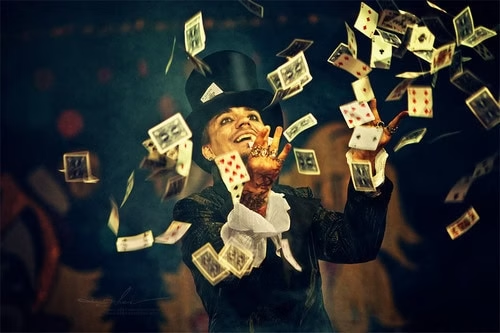
You May be asking yourself why a few of these performers have vanished in the business. If you see their stellar personas, the majority of individuals who share common features that made them famous, however briefly, are features that can be useful in other industries such as media, storytelling, and marketing. Many names you recognize in storytelling and media started as good magicians, viz., Charles Dickens, Johnny Carson, and Steve Martin, to name a few).
- Desire to Be Liked
- Discipline
- Selective
- Innovative
- Optimistic
- Personable
- Commanding
- Ambition
- Curiosity
- Confidence
Desire to Be Liked Like almost everyone, magicians desire to be liked. In the best magician, however, this universal desire is usually coupled with the childhood sense that others don’t accept him as he is, and they dislike him. The combination of a sense of feeling generally disliked, with the universal desire to be liked, motivates the young magician to learn how to trick others into being impressed by him, admiring him, and liking him. Eventually, the magician will learn that it was all an exercise in futility. It’s possible to maintain the facade for years, but admiration is different from liking. Some people are admired, but not well-liked, while others are well-liked but not respected or admired. It is easier to trick people into admiring you than it is to trick people into liking you.
Discipline 
There’s more to being the greatest magician than mastering material. Learning hard magic tricks is easy. Mastering the easy magic tricks takes discipline. A master magician has the freedom to perform masterfully in the moment. All freedom comes from discipline. But after mastering sleight of hand technique, misdirection, and showmanship, the good magician still has all his work ahead of him. Suppose you wake up tomorrow, and you can now perform any and every magic trick flawlessly. Is that skill going to propel you to fame? No! You’ll still need to work tirelessly to promote yourself on TV news stations, on social media (Facebook, Instagram, Twitter, etc.). You’ll need to get a website and you’ll need to design your site. Creating your site is a mammoth task in its own right. Oh, and once your website looks decent, congratulations! It will be in position 94 in Google’s search results. You can’t tell the world you’re the best magician ever. You’ll need to prove it. You’ll need to capture your tricks on video in live performance videos. This is not as easy as you might expect. First, you’ll need to pay a pro to go out when you do, or persuade a friend to go out with you. You’ll approach strangers that look presentable. You’ll perform, and you’ll find that when everything in your performance was perfect (hah!)—a fleet of Harley motorcycles passed byas you were performing, or your camera-person wobbled the cam at the worst moment, or the lighting was awful.
Picture any good magician that comes to mind. Shin Lim, Lance Burton, Ricky Jay, Kreskin, Copperfield, Criss Angel, Jon Finch, David Blaine, Alexander, Dynamo, Derren Brown. The one name that has become synonymous with “magician,” is Harry Houdini.Harry Houdini began as a good card magician. Indeed, when he was younger, he had billed himself as the “King of Kards.” and prominently displayed that moniker on his website. No, he didn’t have a website. But he had that moniker on his business cards. Eventually, he had the business sense to brand himself as the escape artist. His name a hundred years later because he was a disciplined promoter — a promotion genius. Many had performed a straight jacket escape. Houdini was the first to do it hanging upside-down hundreds of feet in the air. This made escaping from the straight jacket easier, but it made for a killer promo photo. The above entertainers weren’texperts at their craft. They had discipline in promotion, branding, marketing, and more. In some cases, theyhappened to mix with influential people; but even then, the magician can’t coast on that for long. Expert magicians work hard notbecause they are aware they are highly paid for their efforts, but to leave a legacy when they’re no longer active in the business. Through discipline comes freedom.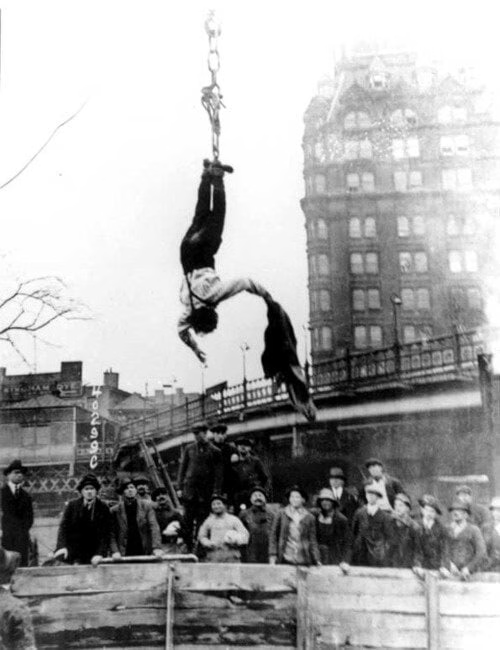
Selective A great magician does not choose his tricks willy-nilly. He has criteria. Each magician has his own set of criteria, which May comprise 5 to 10 rules. A restaurant magician May have the following criteria for selecting his material:- Visual (because the restaurant May be noisy)
- Modular (UK magicians call this “segmented”—multiple climaxes…because frequently the restaurant performer will be interrupted by the server bringing food and drinks, so he needs to be able to end the act on a whim)
- Instant Reset (because the performer can’t afford to spend 20 seconds resetting the trick between each “audience”)
- Packs small (because he’ll be strolling table-to-table, it’s not practical to carry a suitcase full of props)
- Angle proof (because there will people spectating from other tables behind the performer)
A multi-awarded magician is choosy in their functions as well, regardless of the high magician rates he might get for a show. Top-quality magicians that are financially secure perhaps select meaty tricks, routines, and acts that May earn them a FISM award.
Innovative Famous Las Vegas personalities like Siegfried & Roy, Penn & Teller, and funny magicians like the Amazing Johnathan or Mac King, resist the conventional mores societal norms. They never cease producing and reinventing themselves to allow them to grab the public’s interest. Think of any famous magician, and you can quickly think of either a unique trick or a unique persona. Houdini: buried alive, escaping straight jacket, escaping a prison Copperfield: Vanishing the Statue of Liberty, floating over the audience Blaine: the first magician with a decidedly bland persona; card thru window, levitating, producing alligator from Katie Perry’s purse Notice the magic tricks connected to the above performers, they aren’t merely good tricks. A layperson can easily tell the story of the trick. The plot is simple, direct, and clear. There are many great magic tricks whose plots are convoluted and hard to follow. The above tricks are simple (), direct, and clear. A spectator can tell the story. An average performer May present an ingenious trick, but he leaves the spectators with little to sink their teeth in. He May perform the best card trick ever, where a spectator merely thought-of a playing card, and the magician divines the thought-of playing card. But if the spectator tells her friend, “Oh my god.. He got my card!” or “You’ve got to show my friend that one where you got my card!” then the best magician has failed. The magician hands a deck of cards to Wendy. The cards are still in the card box. The magician tells Wendy to think of any playing card. Wendy thinks of a playing card. The magician says, “Wendy, take out the cards which you’ve been holding the entire time, spread through them.” Wendy takes out the cards and spreads through them. Wendy begins to see now that one card is face down, with a red back. She turns it over, and it’s the 4 of clubs. That’s the card she was thinking of. She turns over the remainder of the cards and they all have a blue back. On the back of each of the other cards is written, “Wendy, you’ll think of the 4 of clubs. In your face, Wendy.” That’s a damn good magic trick. But only if the magician is performing for other magicians. A great magician knows he must please an audience of lay people, and his magic tricks must be incredible, but not only incredible but memorable. Is the above trick incredible? Yes. Is the above trick memorable? No. Few witnesses of that magic trick will tell a great story about it. Most will say, “That magician was good with cards” or “He got my card!” Someone who missed out on the miracle, upon hearing the story, “He got my card,” will not be intrigued or impressed. Defying the standard like Dynamo and dismissing the nay-sayers is the best course that magicians have to do to succeed within their showbiz career. Gossips are a part of showbiz and inviting them with open arms can make them more powerful and better magicians.
Optimistic They believe, feel, and dream big. A wistful optimism (that eventually turns to cynicism) motivates them to try their fortune in showbusiness—maybe Las Vegas—hoping they May get the deck stacked in their favor to assist them into their budding career. A pessimist or “realist” would never be drawn to magic. Odds are, such a person doesn’t care much for magic.
Personable Though talent, technique, and showmanship are all essential things to think about when finding a new gift, agents and producers will favor entertainers that have a great way with people and a charismatic presence during an event. Magicians who behave like divas are likely to reduce their likelihood of getting the ideal client relationship because their mindset can result in lots of issues during event performances. A good showman arrives before show time, and he doesn’t cause delays or dead time on the job. He is obsessed with making every moment of the event special and exciting. He can mingle with anybody in the group from the C suite executives to the janitor. His manner is pleasant. Even if a hundred times before he’s been asked the same question, he doesn’t roll his eyes (Is this your full-time job? How long have you been doing magic?), told the same joke (Can you make my wife disappear?), or offered to see a guest perform a trick.
Commanding The good magician knows what can ruin a show (and therefore spoil the fun for the audience), and the best magician knows what is needed for the show to run smoothly. He doesn’t hesitate to take charge of the magic show and take responsibility for any hiccups. The performer needs to manage the audience, direct attention, capture and lead the spectators.
Ambition Both money and fame May lead to frustration if the magician cannot reach them. Some renowned magicians that are getting fewer jobs and their fans are ignoring them are suicidal and depressed. Their depression results from believing that fame and money are the essential matters in a magician’s life. Any profession taken with fire May be a source of your wealth if you understand how to keep the cash as well as earn the cash.
Curiosity Magicians became magicians because they are curious. Not curious like, “I wonder how he did that.” The desire to know the secrets burns like a White heat in the magician’s black heart. Most magicians have gone through a phase where they believe it maybe possible to levitate; and deep down, they are hopeful there is a way to really do it, for real. They are curious to know secrets, but the great illusionists have the self-control to keep the secrets secret. That’s a rare combination.
Unstoppable Confidence Magicians are convinced and decided to pursue their vision no matter what setbacks occur. Magicians who’ve dropped their professions due to a poor attitude have recognized that getting successful doesn’t occur overnight. They must learn the traits which May propel their recognition and finally land them a good deal of high-paying gigs. Though above it was said the best magician likes every aspect of the job, there will be times when that’s not entirely true. To be a successful magician, he must plod forward and remain focused on his goal, despite burn-out. When the public awards the aspiring illusionists with a big break, he’ll see that the contest against the competition is fierce in showbusiness. It might be too late to understand that a young, fresh-faced newcomer will probably supplant your place in showbiz. Getting rich quick is a mere mirage. When you find yourself disenchanted on the summit of your success, stay grounded. Know that, though you finally found yourself at the top of the mountain, the aspirants beneath you are more hungry than you are now. Most magicians want fame prematurely. If you get famous before you are ready, your fall will be sudden and humiliating.
Visibility without credibility is a liability.
It’s important to understand that some of the most successful magicians in the world aren’t famous. If the aspiring magician’s goal is to become famous, then he’ll view fame as a necessary key to his success in achieving this goal. But if the aspiring magician’s goal is to become successful—meaning, to make a great living as a magician—then fame is not a necessary ingredient. Most successful magicians aren’t household names. They aren’t famous. But because they have the traits that made them successful, they earn a comfortable living doing what they love.